Rice Cookers Explained: Basic, Fuzzy Logic and Induction
Three kinds of rice cooker, what each one actually does differently, and how to match one to the rice you eat and the counter space you have.
Our pick Zojirushi Neuro Fuzzy rice cooker
It adjusts heat and timing as the rice cooks, which gives the most forgiving results across white, brown and sushi rice.
We may earn a commission if you buy through links in this guide. How we make money
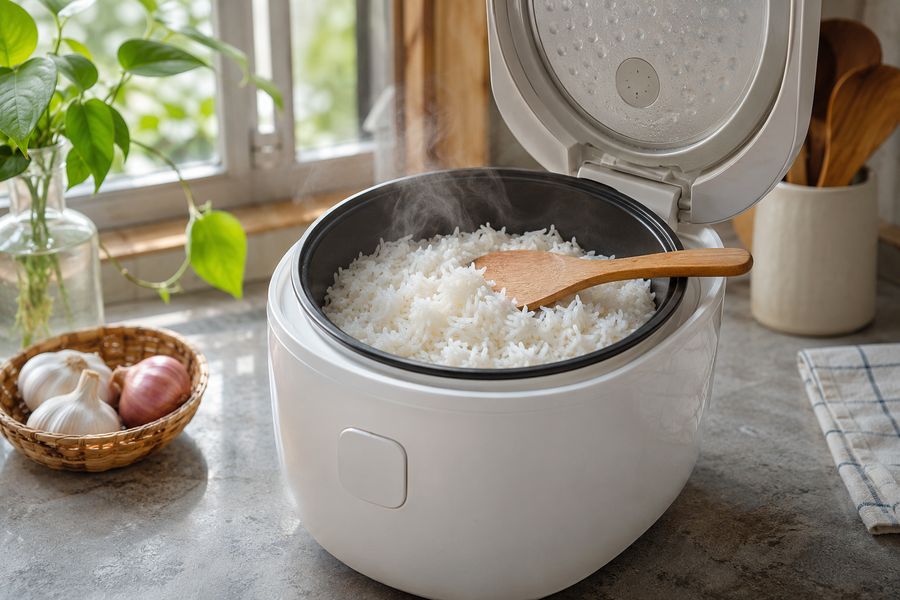
A rice cooker is a pot, a heating plate and a sensor that knows when the water is gone. The three main types differ in how smart that sensor and heater are. Basic models switch off when the pot gets hot. Fuzzy logic models adjust as they go. Induction models heat the whole pot directly.
If you cook rice twice a week and mostly eat white rice, a basic cooker is enough. If you rotate through brown rice, sushi rice and porridge, the extra control is worth paying for.
How a basic rice cooker works
The simplest design has one heating element under the pot and a thermostat. Water boils at a fixed temperature. When the water is absorbed, the pot climbs above that point, the thermostat trips, and the cooker flips to "warm". That is the whole trick.
It works well for long-grain white rice and jasmine rice, which are forgiving. It is less kind to brown rice, which needs longer soaking and a gentler finish, and to short-grain rice, where the bottom layer can turn crusty. Look for a nonstick inner pot, a measuring cup that matches the water lines, and a lid that seals reasonably well.
A familiar example is the Aroma line of cookers, which sit in the budget range and often add a steam tray on top.
What fuzzy logic adds
"Fuzzy logic" is a marketing label for a small computer chip that reads temperature changes and adjusts the heat. It can soak the rice first, boil gently, then rest it. Many models have separate settings for white, brown, sushi, porridge and quick cook.
The payoff is consistency. If you add a little too much or too little water, or the rice is a different age, the cooker compensates a bit. Zojirushi's Neuro Fuzzy line is the one people usually name when they want this, and Tiger and Panasonic make similar models.
These sit in the mid-range. They also tend to have timers, so you can load the pot at breakfast and come home to rice.
Where induction heating fits
Induction heating (often labeled IH) uses a magnetic field to heat the metal inner pot itself, rather than a plate underneath it. The heat is more even around the sides and bottom, and the cooker can change temperature quickly. Pressure induction models go a step further, raising the pressure inside to push water into the grain.
That matters most for brown rice and mixed grains, which are tougher to cook well, and for people who care a lot about texture. The Zojirushi Induction Heating Pressure line and Tiger's IH models are the well-known examples, and they sit at the premium end.
Side by side
| Type | Best for | Price range | Trade-off |
|---|---|---|---|
| Basic (one-button) | White or jasmine rice, small households | Budget | Little control, brown rice can be hit or miss |
| Fuzzy logic | Mixed rice types, timers, porridge | Mid-range | More buttons to learn |
| Induction (IH) | Brown rice, sushi rice, texture fans | Premium | Cost and counter space |
What to check before you buy
- Capacity. Cooker sizes are given in uncooked cups. A 3-cup model suits one or two people. A 5.5-cup or 10-cup model suits families and meal prep.
- Inner pot. A thicker pot holds heat better. Check whether the nonstick coating is replaceable.
- Keep-warm time. If you cook once and eat over several hours, a good keep-warm mode keeps the rice from drying out.
- Cleanup. A removable inner lid or steam vent cap makes washing quicker.
If rice is one part of a bigger cooking routine, our guide to picking a nonstick pan covers the rest of the stovetop.
Quick answers
Do I need to rinse the rice first?
For most white rice, yes. Rinse until the water runs mostly clear. That removes surface starch and keeps grains separate. Some enriched rice labels say not to rinse, so read the package.
Can a rice cooker do anything besides rice?
Most can steam vegetables or fish in a tray, and many fuzzy and induction models have settings for porridge, oatmeal or slow cooking. Check the manual for the modes your model offers.
Is a more expensive cooker worth it for white rice only?
Usually not. The extra money goes to brown rice, sushi rice and special programs. If you eat plain white rice, a basic cooker does the job.
The bottom line
Start with how you eat. Basic for plain white rice, fuzzy logic if your menu varies or you want a timer, induction if texture and brown rice matter to you. A mid-range fuzzy logic cooker is the sensible default for most kitchens.