Knife Sharpeners Compared: Whetstone, Pull-Through and Electric
Whetstone, pull-through or electric? A clear comparison of how each knife sharpener works, what it costs in time and skill, and which one suits your kitchen.
Our pick Combination whetstone, 1000/6000 grit, with a stand
It gives the best edge and lasts for years, once you learn the angle.
We may earn a commission if you buy through links in this guide. How we make money
A sharp knife is safer than a dull one. A dull blade slips, and a slip is when fingers get cut. If your tomatoes are being crushed and your onions fight back, you need a sharpener.
The three main types are whetstones, pull-through sharpeners and electric sharpeners. They trade speed against control, and the right one depends on how much you cook and how patient you are.
Whetstones: the best edge, with a learning curve
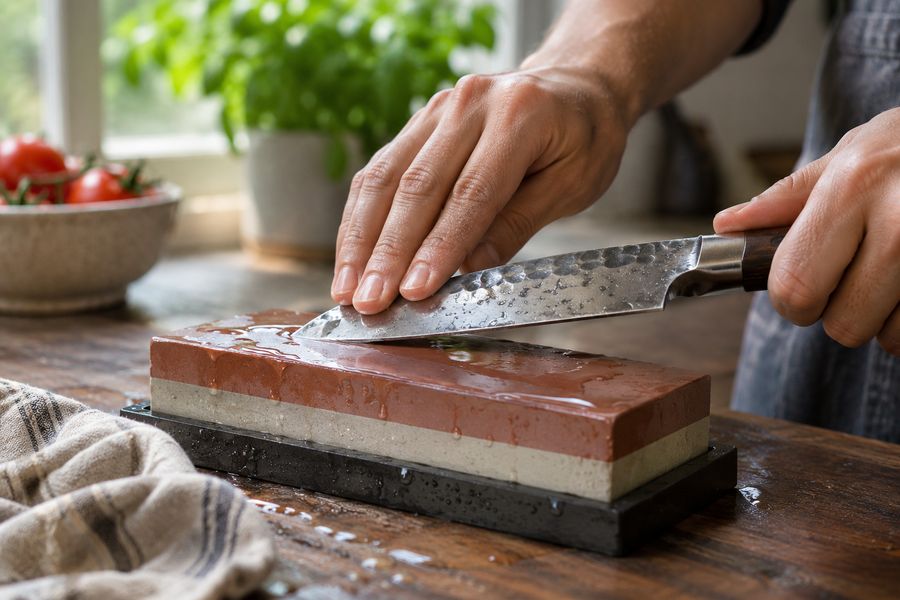
A whetstone is a flat block of abrasive material. You soak it in water, then slide the blade across it at a steady angle. Stones come in grits. A lower number, such as 400 to 1000, removes metal and fixes a dull edge. A higher number, such as 3000 to 6000, polishes the edge to a finer finish.
A 1000/6000 combination stone is the usual starting point. It takes practice to hold the angle, usually around 15 to 20 degrees, but results can be excellent. A stone also lasts for years and works on many knife styles.
Pull-through sharpeners: fast and simple
You pull the blade through slots that hold a fixed angle. It takes a few passes, and anyone can do it. The downside is that these tools remove more metal than needed, and they only work at the angle the maker chose. They are best for everyday stainless knives and not for fine or Japanese blades.
Electric sharpeners: quick but limited
An electric sharpener has spinning abrasive wheels in guided slots. You pass the knife through and it sets the edge. It is fast and takes no skill. It also removes a lot of steel, and the guides may not fit thin blades. For a busy household with standard knives, it is a convenient choice.
Side-by-side comparison
| Type | Skill needed | Speed | Edge quality | Best for |
|---|---|---|---|---|
| Whetstone | Moderate to high | Slow | Excellent | Cooks who care about the edge |
| Pull-through | Very low | Fast | Good, basic | Beginners, quick touch-ups |
| Electric | Low | Very fast | Good | Busy kitchens, standard knives |
| Honing rod | Low | Fast | Realigns only | Weekly maintenance |
Honing is not sharpening. A rod straightens a bent edge but does not remove metal. Use one between sharpenings.
Product lines worth checking: Naniwa, King and Shapton (whetstones), Work Sharp and Chef'sChoice (electric and guided systems), and Wüsthof or Zwilling pull-through models.
Whetstone how-to
- Soak the stone in water for 5 to 10 minutes, or as the maker says.
- Set it on a stand or damp towel so it cannot slide.
- Place the blade at about 15 to 20 degrees, with the edge facing away.
- Push the blade along the stone with light pressure, from heel to tip.
- Do the same number of strokes on each side.
- Move to the finer grit and repeat with lighter pressure.
- Rinse and dry the knife carefully.
Your sharp knives also need something kind to cut on. See our guide to cutting boards that protect knife edges.
How to tell when a knife is dull
Do not wait until a knife is useless. A few simple signs say it is time.
- It slides off a tomato skin instead of biting in.
- You need to press hard, or saw, to get through an onion.
- The edge catches light. A dull edge has a thin bright line when you look straight down at it, because it is rounded.
- A sheet of paper tears instead of slicing cleanly when you cut it.
Also think about the steel. Softer European-style knives take an edge quickly and lose it quickly, so they like frequent honing. Harder Japanese-style knives hold an edge longer but can chip on a pull-through slot, which is another reason to pick a stone for them.
Quick answers
How often should I sharpen?
For home cooks, a couple of times a year is common, with honing in between. Sharpen when the knife starts crushing food.
Can I sharpen serrated knives?
Not on a flat stone. They need a tapered rod or a professional.
Is it safe to sharpen expensive knives at home?
A stone can do it well with practice. If you are nervous, practice on a cheaper knife first, or use a sharpening service.
The bottom line
If you enjoy hands-on work, buy a 1000/6000 whetstone and a stand. If you want a sharp knife in a minute and little fuss, a pull-through or electric sharpener will do. Whichever you pick, hone regularly and keep your knives off hard surfaces.