Cat Trees and Scratchers for Small Apartments
How to pick a compact cat tree and the right scratchers for a small apartment: height, stability, materials and where to place them so your cat actually uses them.
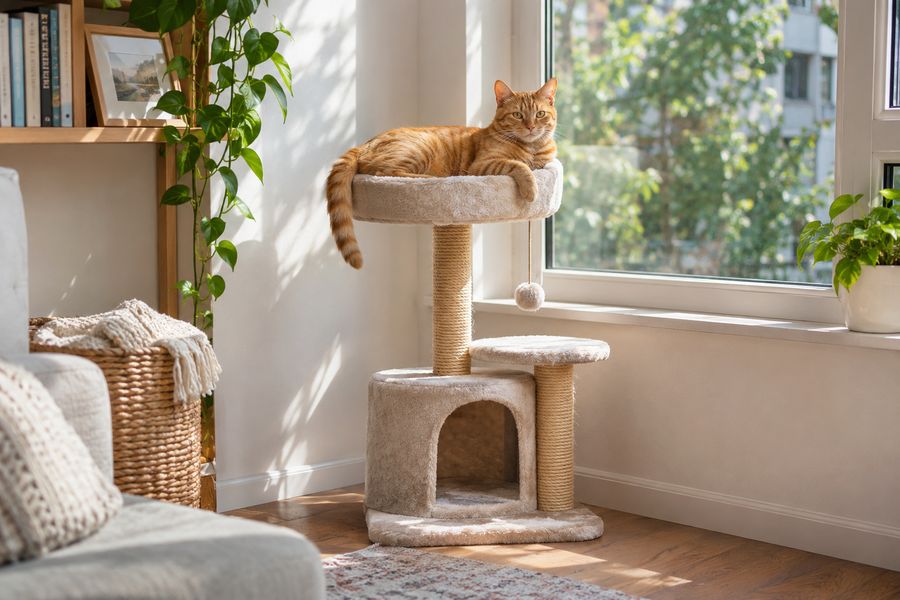
Our pick Compact cat tree with sisal posts
A narrow footprint with sisal posts gives climbing and scratching in one piece that fits beside a window.
We may earn a commission if you buy through links in this guide. How we make money
A small apartment does not mean a small life for a cat. Cats like height, a window and something to scratch. A narrow cat tree and one or two scratchers can cover all three without taking over the living room.
Here is how to choose, and where to put things so they get used.
What a cat needs
Cats scratch to stretch, mark territory and keep claws in shape. They climb to watch the room from a safe spot. If there is no good place to do either, furniture takes the hit. Offer a tall post and a flat scratcher, then watch which one your cat prefers.
Picking a cat tree for a small space
- Footprint over height. A tall, narrow tree uses vertical space. Look at the base measurements, not just the height.
- Stability. A wobbly tree gets ignored. A wide, heavy base or a tree that can be anchored to a wall is safer.
- Platform size. The top perch should fit your cat's whole body. Large breeds like Maine Coons need a bigger platform than small cats.
- Sisal posts. Rope-wrapped posts take scratching well and last longer than carpet.
- Easy cleaning. Removable covers or wipeable surfaces help with hair.
Brands such as Frisco, Armarkat, Go Pet Club and Feandrea make compact trees in the budget to mid-range.
Window perches and wall-mounted shelves are another way to add height with no floor space. Look for products rated for your cat's weight.
Scratchers: three shapes
| Type | Good for | Notes |
|---|---|---|
| Vertical post | Cats that stretch up | Should be tall enough for a full stretch and stable |
| Flat or angled pad | Cats that scratch low | Corrugated cardboard is cheap and popular |
| Wall-mounted or door hanger | Tight spaces | Saves floor space |
Cardboard scratchers wear out and need replacing, but many cats love them. Sisal-covered pads last longer. Rub a little catnip on a new scratcher, or place it next to where your cat already scratches.
Where to put them
Near a window is best. Cats like to watch the street. Place a scratcher next to the sofa arm or wherever they already scratch, because the location matters as much as the style. Move a tree to the room where you spend time, since cats like to be near their people.
Keep trees away from heaters and from shelves with breakable items. If you have a hair problem on the couch, see pet hair removal.
Get them using it
- Use treats or a feather toy to lead your cat up the first time.
- Do not force paws onto a post.
- Give them a few days. Cats take their time with new things.
- Keep the old scratching spot covered with double-sided tape or a throw while the new one catches on.
If a litter box shares the space, our guide to litter boxes helps you keep it out of the way.
Safety and upkeep
Check the tree for loose screws every month or two, because cats jump hard and fittings can slacken over time. Tighten them with the tool in the box. Replace worn sisal when it frays, since loose threads can catch claws. Vacuum the platforms and wash removable covers to keep hair down.
If you have more than one cat, give each a perch of their own so no one gets cornered. Kittens and older cats do better with low platforms and short hops, so choose a tree with gentle steps. If your cat seems to struggle with jumping, mention it to your vet.
Quick answers
How tall should a cat tree be?
For small apartments, 3 to 5 feet is enough. Taller works if the base is stable.
Should I declaw instead?
No. Declawing is a surgery with lasting effects, and many vets advise against it. Talk to your vet about scratching problems.
My cat ignores the tree. Now what?
Move it near a window or the couch, add catnip or a toy and be patient. If behavior changes suddenly, check in with your vet.
The bottom line
Pick a stable, narrow cat tree with sisal posts and a perch by a window, then add a flat scratcher where your cat already scratches. Measure the space first, and expect a few days before your cat adopts it.